
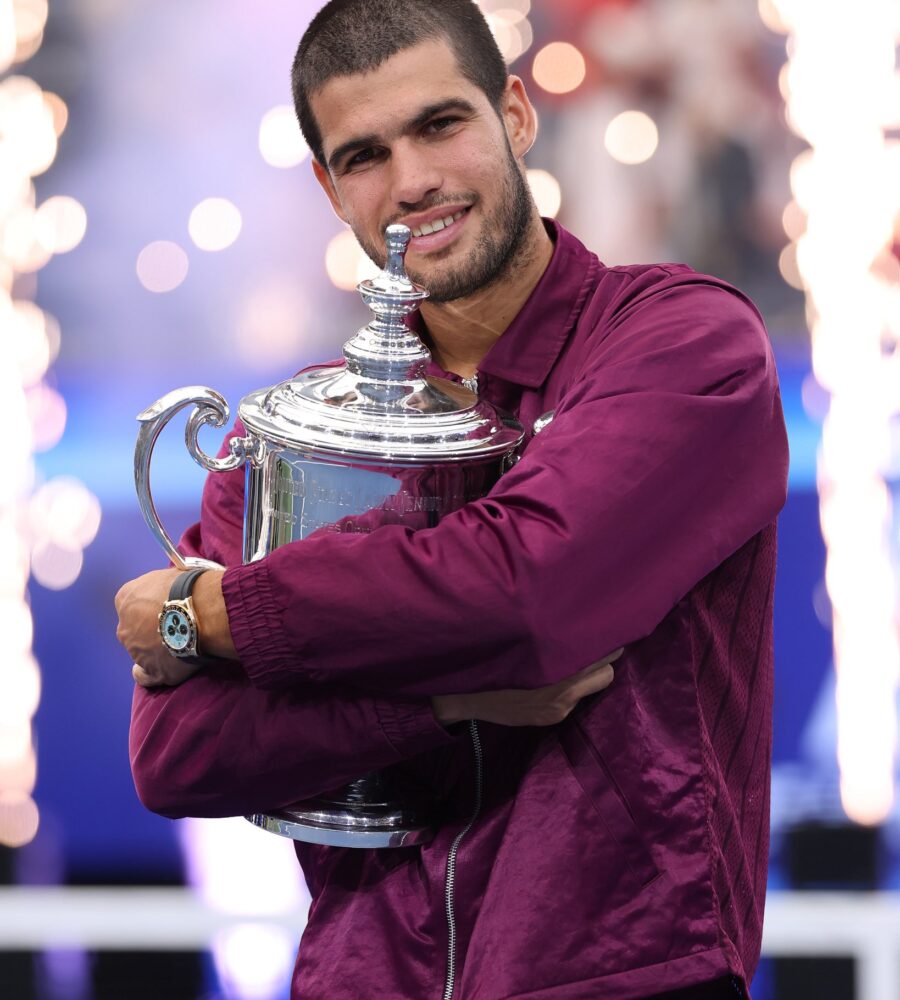
The Athletic has live coverage of the U.S. Open men’s final featuring Jannik Sinner vs. Carlos Alcaraz
Welcome to the U.S. Open briefing, where The Athletic will explain the stories behind the stories on each day of the tournament.
On Day 12, the men’s final was set after two very different matches, and Taylor Townsend’s U.S. Open ended in triumph.
Here they go again
After 126 matches, the U.S. Open men’s singles will finish with the one the tournament has been waiting for.
For the third time in a row at a Grand Slam, Jannik Sinner, 24, and Carlos Alcaraz, 22, will contest the final. It is the first time in the Open Era of tennis that two players have played three consecutive major finals against each other in the same year.
Judging by their form in New York, it’s no surprise:
- Sinner and Alcaraz have dropped two sets between them all tournament.
- Sinner has been broken four times, Alcaraz twice.
- They could both lose more sets against one another Sunday than they have done in their other six matches combined.
These remarkable numbers bear witness to what becomes obvious with every passing tournament: The rest of the field combined can’t get close to what Sinner and Alcaraz can do to each other as individuals.
Except perhaps the version of Félix Auger-Aliassime that took to Arthur Ashe Stadium last night. Sinner beat the Canadian 6-1, 3-6, 6-3, 6-4, but the victory was anything but routine. Auger-Aliassime played some of his best tennis since the early 2020s in the second and fourth sets, winning the former and pushing Sinner to the edge of going a break down for 3-1 in the latter.
The world No. 1 had left the court for a medical timeout after losing the second set, and was sweating heavily from the first set onward on a pleasant 77-degree evening.
“It’s nothing too serious,” Sinner said.
The last time they played here in 2022, Sinner and Alcaraz produced five hours and 15 minutes of scintillating action that changed tennis forever.
It is now confirmed that they will split the four major titles for the second season in a row. Sunday’s winner will be world No. 1; their gap to No. 3, Alexander Zverev, is now almost 5,000 ranking points.
And every time they play each other, they sharpen their tennis and move further away from the rest of the field, as happened with the Big Three of Roger Federer, Rafael Nadal and Novak Djokovic.
This match feels like a paradox: a Grand Slam final that neither player can lose. When it’s over, there will be a champion and a runner-up, but in the bigger picture, this is just another piece in an overwhelming dossier of evidence that Sinner and Alcaraz take each other to heights far too high for their competitors
— Charlie Eccleshare
How Alcaraz overcame his Djokovic demons
This was the afternoon Carlos Alcaraz had been working toward for eight months.
Facing the greatest player of the modern era, and the demons that come with trying to vanquish him, Alcaraz outmuscled and out-mettled Novak Djokovic on a hard court for the first time in his career. He beat the 24-time Grand Slam champion 6-4, 7-6(4), 6-2 to make the U.S. Open final for the first time in three years, where he will face Sinner for the third major final in a row. That had never happened in the Open Era of tennis until now.
For Alcaraz, the win was both decisive and tight all at once. Every time the 38-year-old Djokovic sprinted across the court to catch up with one of Alacaraz’s feathered drop shots, the roars and screams and chants of “NO-vak, NO-vak…” echoed around the hulking concrete bowl by Flushing Bay. The crowd had come to see the Djokovic show, and when he recovered from losing the first set to lead 3-0 in the second, it was on:
- Even in winning the opening set, Alcaraz’s decision-making had been strange. He rarely hit the ball into space, instead going right at Djokovic when the Serb was out of position and inviting him back into points that looked lost.
- This culminated in the point that saw him broken at the start of the second set. Alcaraz flowed forward behind a forehand, but chose to try to fool Djokovic by volleying back behind him, instead of into space. Djokovic, who had no realistic hope of covering the space, just stayed where he was and won the point to break:

(U.S. Open)
But unlike at the Australian Open eight months ago, when an injured Djokovic scrambled Alcaraz’s brain and beat him in four sets, the 22-year-old Spaniard did not continue to get frazzled. He reset, broke back and stayed in until a tiebreak. At that point, it was Djokovic’s turn to lose his nerve.
Knowing his fate hung in the balance of the next dozen points, Djokovic played with a rare stress that only Alcaraz and Jannik Sinner have been able to evoke of late.
Once the king of locking down in one error-free tiebreak after another, Djokovic appeared to panic. He rushed a serve-and-volley attempt on the first point, after playing nearly a set of flawless tennis without it. He pulled the trigger too early in rallies and missed. He hit a poor drop shot to allow Alcaraz to get to a 4-1 lead.
He staged a mini-recovery, winning three of the next four points, but it was too little, too late. Alcaraz blasted a 131mph serve down the middle that landed like a roundhouse right to the jaw, then kicked in a second serve on set point. Djokovic, probably the greatest returner ever with probably the greatest backhand ever, took his backhand cut and sailed it long.
The match was over then, even with another set to play, and once it was really over, Alcaraz was into his third Grand Slam final of the year.
The larger question for Djokovic? Whether or not he is content to beat everyone in a Grand Slam, except the two best players in the world. They are 22 and 24 and seemingly aren’t going anywhere. They appear to be an insurmountable obstacle, unlike anything he has confronted in his career.
Source : The Athletic