





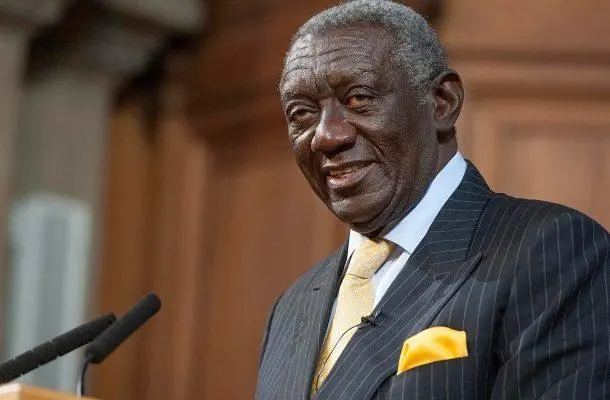
In a major development within Ghana’s ongoing constitutional review debate, former President John Agyekum Kufuor has publicly endorsed proposals to extend the nation’s presidential term from four years to five. His stance places him directly at odds with the official position of his own political tradition, the ruling New Patriotic Party (NPP).
Speaking in an exclusive interview with JoyNews, the statesman reaffirmed his long-held conviction that the existing four-year cycle under the 1992 Constitution is insufficient for any administration to effectively execute long-term development programs and deliver meaningful progress.
Watch
Addressing the practical governance challenges created by four-year terms, Kufuor pointed out that the political calendar leaves very little time for actual governance.
“Four years is too short for a young nation that is trying to develop,” Kufuor stated during the interview. “The fourth year is an election year; election year anywhere in the world is a mud year.
According to the former president, new administrations often spend their first year settling in, assembling cabinets, and reviewing inherited policies. By their fourth year, governance is heavily disrupted as political figures shift their focus to campaigning and electioneering. A five-year mandate, Kufuor argued, would grant governments a solid three-to-four-year window to implement substantive policies before entering campaign mode in the final year.
Partisan Friction: Breaking Ranks with the NPP
Kufuor’s comments highlight a key divide between elder statesmen and current party leadership. While the proposal to reform the presidential tenure forms part of broader constitutional reform discussions, elements within the NPP have consistently resisted changing the status quo. NPP traditionalists argue that four-year cycles ensure frequent public accountability and prevent potential authoritarian overreach or prolonged periods under underperforming leaders.
Acknowledging his departure from his party’s stance, Kufuor made it clear that principle outweighs partisan consensus on this issue. “Now I say five years. If, for whatever reason, my party (NPP) says no, that is their point of view,” he asserted, underscoring his independent outlook on democratic development.
A Recurring Debate in Ghanaian Politics
The debate over presidential term lengths in Ghana is not new. Ever since the restoration of constitutional democracy in 1992, legal experts, policy analysts, and governance advocates have debated whether the American-style four-year term serves a developing West African democracy well.
Proponents of reform including several constitutional law experts and former statesmen argue that short political cycles encourage policy inconsistency, abandoned infrastructure projects, and short-term political decision-making. Opponents, however, contend that changing term lengths risks destabilizing Ghana’s electoral rhythm and that four years is sufficient if a government operates efficiently.
Implications for Constitutional Reform
Kufuor’s public support re-energizes the movement for constitutional amendment. Changing the presidential term from four to five years would require an amendment to entrenched provisions of the 1992 Constitution, a process demanding a broad national consensus, a two-thirds majority in Parliament, and a national referendum.
As discussions surrounding constitutional amendments heat up, Kufuor’s commentary guarantees that the presidential tenure issue will remain at the forefront of Ghana’s national governance dialogue.



Reader comments